Thursday, April 21, 2016

Barcelona Revisited

Barcelona was the McGriff family's first European vacation.  It was the first vacation where we learned to integrate learning, travel and fun.  My kids started learning and using another language.  We were introduced to Antoni Gaudi, Picasso, Miró, and amazing European markets full of fresh fruits, vegetables, meats, sausages and lots of other sights and smells.  
Barcelona is definitely a city that imprints in your memory- full of colorful modernist art and even more colorful people- so when Wilson and Camille chose it as a "we are finished with Spanish II" destination we were thrilled.  And while a LOT has changed in the last 5 years, the city still holds much of the same charm that we remembered.  And to share it with good friends adds another layer of good memories.

Since our last trip here, Barcelona has grown.  One cab driver told us the population is over 8 million and it has been the most visited city in Europe for the last two years.  The traffic has taken its toll.  Las Ramblas is crowded and many wonderful sites that were previously open are now paid admission with controlled entries of a certain number of people per hour.  Those situations did not diminish the fun, just called for a little more planning...

 Camille and Wilson were excited to see that those CRPs from Spanish really do pay off- in fact, all their Spanish did.  Even though the region of Catalonia is determined to keep their native language, Catalan, alive- most signs and most people will speak to you in Castilian Spanish.  They both hit the ground talking to taxi drivers, waiters, hoteliers, and vendors.  I was amazed by their comprehension, big vocabulary and proper use of tenses!  Bueno trabajo Señora Holt y Señora Hicks.  Camille worked hard to start conversations with several cab drivers and we got great insights into their opinions on Catalan independence, the 1992 Olympics, tourism in their city, and one cab driver ended up becoming half tour guide sharing his 1992 Olympic stories and making sure we found the Olympic Stadium and saw the torch.  His comment...."en television mis amigos dicen muy grande, per yo estuve por mirar- esta muy pequeño!"

Both our families had great memories of La Boqueria from previous trips.  It is not easily forgotten and is the polar opposite of the Cours Saleya that has become our daily shopping spot in Nice.  The Boqueria is loud, crowded, and packed to the roof with loads of fresh everything.  For some people it might be a lot to stomach early in the morning but if you can get avoid spending lots of time next to the seafood, there is beautiful fruit, fresh hot tortillas, churros, juice, and coffee.  A good start to the day with hungry teenagers.  


and for 7 people, figuring out public transportation is a must, and a celebration...


      La Sagrada Familia-Fall 2010                                                La Sagrada Familia-Spring 2016

Over 130 years ago, the Catalan cathedral was begun by a devout Barcelonan bookseller, Josep Maria Bocabella, who acquired the land in the Example and planned to dedicate the temple to the Holy Family.  A diocesan architect was originally put in charge of the project but within 10 years had resigned over differences with the builder.  In 1883, Antoni Gaudi, at age 31, began working on the structure and it was to become his life's work.  His mathematical mind is reflected in the hyperboloids, parabolas, and in the basic module which is 7.5 by 7.5 meters and every other interior measurement is a multiple of that.  Gaudi was influenced by Moorish, Mujedar, and Oriental art and all of this blended to him becoming one of the leading artists of Catalan Modernism and Art Nouveau.


The same things that enamored me with this city continue to glow.  The absolute genius of Gaudi's architecture, his forward thinking designs and innovative ideas continue to amaze.  Trencadís was a form of mosaic tilework he created that allowed him to tile his curved space.  Before central air-conditioning he created an attic in Casa Batlló that moved air throughout the attic and down the central staircase.  The glazed tile walls of the staircase are a darker blue at the top and lighter at the bottom so that when light shines in, they all appear to be the same.  Everything he created, from the vented doors to ergonomic doorknobs are evidence that he was truly one of the greatest minds of his time.  And his range was broad.  Whether working on an apartment building for Barcelona's elite, a housing development outside of town, or a cathedral that will serve to glorify God for centuries, his ingenuity and playful style show through.  One of the quotes in our book says that his professor upon bestowing his architecture degree said of Gaudi, "I don't know whether we are giving this degree to a genius or a madman."  Maybe, I think, to be that far ahead of your time, you are a little of both.


I had never seen the schoolhouse outside La Sagrada Familia.  It was built for local children and those of the workmen on the project.  Its simple lines, no square angles, and bright spaces would have provided a perfect environment for learning.  
"When the building simply has what it needs with the resources available it has character, or dignity, which is the same thing."-Antoni Gaudi


And the food- not forgotten- and happily repeated.  The chocolate so thick you could eat it with a spoon and hot churros.  The tapas bars where you eat what you want and they charge by the toothpicks.  And my favorite, jambon iberico, Iberian ham that is so flavorful that two paper thin slices are enough for a whole bocadillo.


And while this trip had the undertones of familiarity and the next layer of exploration of favorite spots, we also found time for some new things too.  The Musee Maritim where Pete got to see the first Snipe ever built and the Flying Dutchman that took gold in the 1992 Olympics, and the Olympic stadium and museum which were so fun, educational and UNCROWDED.


So, al fin de la viaje, I am joyful that we had the chance to rediscover Barcelona.  The city that sent explorers to the New World and fostered artists that charted new territory.  Maybe each of us can take a little bit of that with us.


This morning...at the Immigration office...


On this trip, we have crossed several hurdles, both official and cultural, to attempt to integrate into this country.  First, was the library cards, trying to obtain proctoring for exams.
Next was the Yacht Club membership,
and even the grocery discount cards...
All of these were really warm ups for the real thing...

Two months ago, on March 14th, while I was living la Dolce vita in Northern Italy I received these two emails which I quickly forwarded to Kelly Bullington labeled S#*% and S#*% part deux.


From: convoimmi2@ofii.fr
Date: March 14, 2016 at 11:01:23 AM GMT+1
To: MCGRIFFK@BELLSOUTH.NET
Subject: Convocation pour la visite médicale
Madame, monsieur,
L'OFII, dans le cadre de ses différents dispositifs vous convoque pour la visite médicale
Dans ce contexte vous êtes convoqué(e) :
 Le 07/04/2016 à 08:30 heures
Vous trouverez dans le fichier joint tous les détails de cette convocation.

Merci de ne pas répondre à ce message.

L'Office Français de l'immigration et de l'intégration.


For those non-French speakers out there...these were "invitations" for me to show up at the Office of Immigration and Integration for a medical exam.  Needless to say, KB celebrated until she realized that she too had received these two letters.  Luckily, I was able to get my appointment postponed since the children and I were in Hyères for the Europacup on 07 avril.  Poor KB had to be the first to enter the system.  Thanks to her trailblazing, at least I knew what to expect.  My appointment was kindly rescheduled for 21 avril, 8H30.


I took a taxi this morning to the visa office- no reason for any additional anxiety from public transportation.  I have a huge binder of paperwork, photos, passport, international health insurance and a receipt for 241 euro to get another stamp in my passport so I can stay here.  The French understand ma français when they feel like it, yet no one has a problem taking my money.  
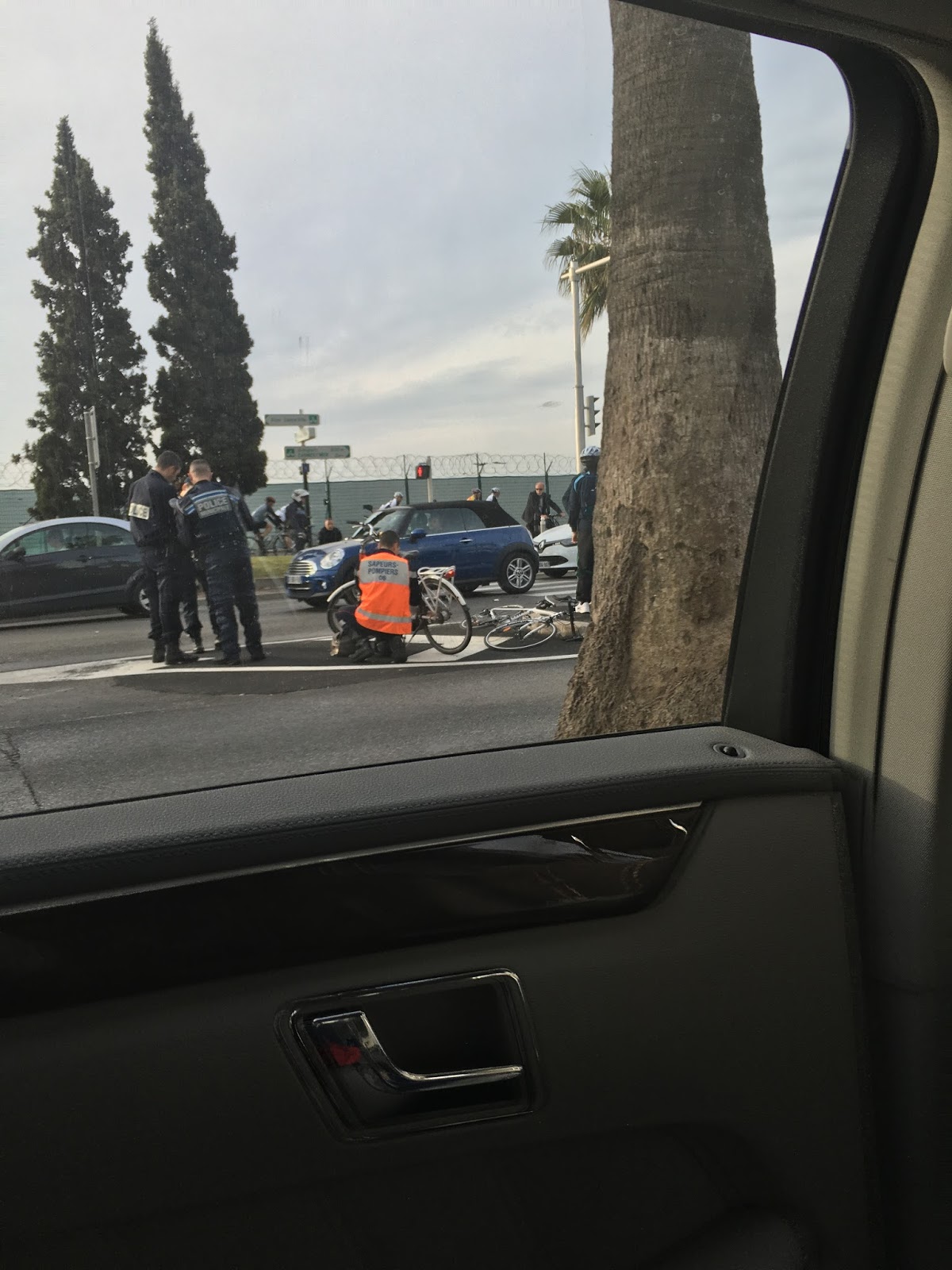
I spent the money on the taxi to avoid stress and then there was "une accidente " with Les velos(bicycles) et les voitures(cars)  

Needless to say, many emergency vehicles and commuters jammed on the Promenade des Anglais this morning at 7:50am.  


37 euro for the taxi- 
20 minutes in the grimy hallway-


a security guard with a wand checking paperwork-

and a receptionist later---I am sitting in the waiting room with a Moroccan student, a Russian housewife, Japanese students, a Muslim looking guy on a laptop, an Indian in Tevas, working on a cell phone and some Asian girls...


The Russian lady and I are the paleest and cleanest of the group.. She explained that she and her husband wanted to buy a place in California but the visa requirements were too stringent- and while she admits that the French bureaucracy is annoying, the Schengen visa is easier... And they fly here door to door in 5 hours.  

The morning chatter among employees is infuriating, I need another cup of coffee and they are taking their time- their sense of urgency seems to be missing- 
30 minutes after our appointment time, A woman in a white medical jacket just came in and called 3 students by name.  She had large paper clipped papers for each of them.  Is there a way to make sure I have a group of papers in that stack?
And we wait...

9:07
They know my name!!! They just called me and my new Russian friend to a better hall. I am in the system, no turning back now
9:11
My Russian friend is already out said they check eyes in the first room.
C'est tout .

9:29
Moving through the system- 
I was called into the first room, she checked my eyes, had me read a French passage which I butchered, weighed(a little extra considering les baguettes et les croissants) and measured me(I am tall enough to be in France) and checked passport and insurance.

Then another room where I had to take off my shirt and get a chest X-ray.
Each of them ask if I speak French - My patent response- un petit peux- Their patent response is that we will continue en français until you can't understand anymore...I continue to try, most of the instructions I can understand there are words like l'oriel(eyes), assurance(insurance), chemise(shirt) and directional words like à droit (to the right) that keep me from looking completely foolish.  

Next stop, a sweet man asking about my health, it took him several times to convince himself that my blood pressure was really that low, confirmed from my X-ray that I didn't have tuberculosis.  He stamps the visa application.

Then a lady at a desk....
Passport-check
Certificate de domicile(proof that I have a roof over my head)-check
Timbre(stamp that I paid 241euro for this awesomely fun morning excursion)-check
She puts a printed stamp in the passport...

9:48
Je suis finit!
And I rode the velobleu home! Feeling like an official French visiteur.


Friday, April 1, 2016

Connections

Today, I helped a french lady navigate the machines at le gare en français, I spoke to a lady at the tram station who thought I was Spanish, and even the cashier at FNAC (pronounced fe-nack) thought I was English (as in from England).  Ladies and gentlemen, there is a bigger world out there.  They speak different languages and they have different cultural norms.  With the internet and the growth of global businesses, we can meet anyone and experience things on a global scale.


The problem is- how can we attempt to understand the human on the other end of the line?  There many societal and linguistic nuances that are easily misconstrued.  Think how easy it is to confuse the English language- just this week Camille had to do a project in her virtual English class on similar words with different meanings- coarse vs. course, compliment vs. complement, loose vs. lose.  When the language we were raised with poses problems, how can we assume that this global world will function without cultural understanding as well?

Last week before Kelly got here, Pete had an infection on his leg.  We weren't sure if it was a bug bite or something else.  For two days we cleaned it, soaked it, and elevated it hoping he would get better.  He didn't.  Within 48 hours, I was calling the English speaking doctor and Camille and I were looking for a pharmacy that was open on Sundays.  The result was a crazy (public transportation doesn't always work) bike ride up a mountain to the doctor, who wrote a 5 different prescriptions (one was for bandaids); a trip to the lab for tests (no one spoke English); and the pharmacy.  As a mother, I couldn't help but worry about what was getting lost in translation.  Did the doctor truly understand all the information?  Did the lab understand that I wanted it tested for MRSA? Did I really understand the prescription instructions?  The answers were yes- He was doing much better in a couple of days and was almost perfect by the time Kelly and Mallory got here.  The entire experience turned out great, and thank
goodness it happened with at least a month of French and navigating French systems under my belt.

After two weeks, I was getting along pretty well in France.  I had no problem ordering meals, making purchases in the market, or buying train tickets.  I learned that they EXPECT to be greeted- bonjour in the morning or bonsoir after 5pm before you start your business or ask your questions.  I have also learned that niceties like bon journèe (have a good day) go a long way in making you seem more polite.  Now, halfway through our adventure, I can have mediocre conversations with the bakers downstairs.  Yesterday it was over how much I liked their newly remodeled space and how angry I was about the graffiti "tags" on la porte de mon edifice (my apartment building door).   However, even after 6 weeks, the french phone call is still a source of fear and confusion.  I can only surmise that my accent is atrocious (hence the Parisian asking if I was Spanish), and many times, I say the correct word but they cannot understand me.  On the way to the yacht club for their first practice I reminded the children that it is up to them to speak French, not the French sailors to speak English.  If a French person came to Fairhope we would be nice to them and help them as much as possible, but I would not feel it my responsibility to learn French to help them.

I read an article last week in The New Yorker about a new school designed by Silicon Valley executives called the AltSchool.  Everything about the school sounds amazing- it offers a "highly tailored education that uses technology to target each student's 'needs and passions.'" But even the founder of the AltSchool thinks that we will all be walking around with personal translators in a few years, and the need to spend time and energy learning languages might be better spent on other subjects.  That may be true, but I still think the societal differences and real conversations come not
from just communicating but connecting.  An article on a website called InsideHigherEd shows that, statistically, foreign language studies are on the decline in US colleges and universities.  An associate professor and chair of the department of Spanish and Portuguese studies at the University of Florida, Gillian Lord, was quoted as saying that the decline in Spanish enrollments across the country was part of a trend away from the humanities.  "Our students are under increasing pressure to go to college so that they can get a high-paying job upon graduation, which of course is a worthy goal, but what used to be the underlying assumptions behind that goal--strength in liberal arts, broad disciplines, critical thinking, etc.--seems to have fallen by the wayside in recent years."  I couldn't agree more.

One of the many opportunities this spring has given us is the chance to make connections, those critical thinking, strong liberal arts kind of connections.  We just discussed Pete's Medieval Civilizations Lab project and how the village we visited on Monday, Les Baux des Provence, was a feudal village with the Les Baux (descendants of Balthazar, the magi) family operating as Lords over the region of Provence.  Situated on top of a rocky outcrop, you could see all the olive groves and vineyards that would have been farmed by the serfs and freeholders.   We have had conversations about Roman engineering, bringing fresh water to villages not only for drinking and bathing but also for dyeing fabrics and other labor specific activities.  We have read translations of Roman writing-thank goodness someone chose to study Latin.  We have seen


buildings where, after the Roman letters were removed, archaeologists had to decipher what letters had been mounted on the building only using the holes where the letters had been as clues.  We have had conversations about the family in Limone, Italy whose blood has been the focus of 5 international scientific congresses.  The Pomaroli family, with about forty living members, all descended from a couple married in the 1600s.  Their blood contains an apoprotein making them immune to cardiac infarction and arteriosclerosis.  Scientists have been able to isolate that protein and reproduce it and the resulting medications are currently being tested.  The conversations resulting from that museum visit have ranged from fictional reasons, for the blessing of the family, to biological anthropology, and
what we have to learn from other cultural diets, lifestyles, and practices.

While English is most certainly becoming the common language of business, computers, and finance, we also hear it used as the common language for travelers.  A Japanese couple asked me for directions last week- I think it was because they spoke English, not French.  However, when we all have to go to our second language to communicate, how much is lost in translation?  This morning when Kelly and Mallory headed back to the airport, we were all sad.  We will miss them for sure, but we miss the conversation the most.  The ability to talk and share ideas in our language is priceless.  That is probably the one thing I struggle with the most.  I like people and I like making friends, and the challenge is to connect a little further than -how much? or       -where? or -when? While we work on it, we are thankful for our great friends, the Bullingtons, who we get to share this experience with, and for those who take the time and effort to come see us.